Officials
responded relatively quickly to the catastrophe. Since the majority of the
environmental issues surrounding the spill had to do with oil slicks that had
collected on the surface of the ocean and the sea bed, as well as microscopic
oil particles that had scattered throughout the Gulf. To solve these problems,
officials used a variety of methods, most notably including chemical
dispersants and burning (Jamall, 2012). Although
both approaches worked relatively well, the solutions have since become part of
the problem.
Dispersants
employed by officials, although effective in dissolving petroleum, contained 2-butoxyethanol acetate, a chemical listed on the Agency for Toxic
Substances and Disease Registry’s toxic substances list, and appears in 20 of
the sites considered to be “National Priorities” by the Environmental
Protection Agency (ATSDR, 2011). On the ATSDR site, too much 2-butoxyethanol
acetate in the body is described as having mild effects on humans, with
symptoms such as vomiting and headaches, however, in animals, specifically
small animals, the impacts are much more significant. In fact, 2-butoxyethanol
acetate is a confirmed teratogen in animals, causing reproductive problems and
birth defects (ATSDR, 2011). Despite several years and several generations of
shrimp passing, 2 years after the effects of the dangerous chemical have become
clear. On April 20, 2012, the news site Al-Jazeera released a startling report
from Barataria, Louisiana. In the report, two fishers, Tracy Kuhns and Mike
Roberts, showed samples of white shrimp caught in the bay that were eyeless.
“Disturbingly,” Kuhns says, “not only do the shrimp lack eyes, they even lack
sockets.” Kuhns also claims that 50% of all white shrimp caught in the bay in
the previous fishing season were the same way (Jamall, 2012). These problems
most certainly originated from the dispersants, which in animals is considered
as harmful as a human mother using cocaine during pregnancy (howMed, 2011).
 |
| http://2.bp.blogspot.com/-HmA--u1nB7A/T5AaD6mm6DI/AAAAAAAAMG8/Uv-9HSImF9A/s1600/bpfishdeformation.jpg |
The problems do
not stop there. Although a 2013 report from the National Wildlife Foundation
categorized shrimp status in the gulf as “good” at the present, it did concede
that damage to the Gulf ecosystem will have negative impacts on shrimp in the
future (Inkley, 2013). Prolonged and false security has been seen before in
populations that have been effected by an environmental disaster, for example,
in the wake of the 1989 Exxon Valdez spill herring appeared to be doing fairly
well before their population collapsed four years later in 1993 (McConnaughey, 2012). Shrimp may be in for a similar collapse as both food webs and habitats
become increasingly unsustainable due to the Gulf spill.
Firstly, damage
to phytoplankton and ciliate populations due to the spill may cause problems to
move up the food chain towards shrimp. In a 2012 study, researcher Alice
Ortmann investigated the impact of the oil spill on phytoplankton and ciliates
by simulating a Gulf micro-ecosystem in her lab before adding oil spill-related
chemicals to the tanks. Once again, dispersants used to dissolve oil seemed to
be the problem. In tanks contaminated with dispersant agents, plankton and
ciliate numbers dropped significantly. Both organisms are especially important
to the Gulf ecosystem. Phytoplankton act as one of the ecosystem’s primary producers,
taking energy from the sun through photosynthesis. Ciliates, on the other hand,
are important primary consumers, being one of the only organisms that feed on
and take energy from ocean bacteria, the other important primary producer in
the food chain. This is especially concerning, as Ortmann explains, “In those
tanks, all the energy gets trapped in the bacterial side. There were lots of
bacteria left but no bigger things. It’s like the middle part of the food web.”
This does not bode well for the rest of the food web (McConnaughey, 2012).
Energy flow, the transfer of energy from one organism in the food chain to
another, is very inefficient enough, as roughly 10% of total energy gets
transferred from one organism to the next. For example, when shrimp get energy
from eating, 90% of the energy received from eating is consumed in bodily
processes, whereas only 10% gets passed on to its predators when the shrimp
itself gets eaten. The inefficiency of energy flow means that ecosystems are
generally very fragile and that food chains very much depend on the 10% of
energy that gets passed on from organism to organism. The 10% rule dictates
that ecosystems are pyramids, with primary producers forming a wide, large
population at the base and predators forming the top. Should the base be
thinned out, the rest of the pyramid will shrink as well (Crash Course, 2012).
Precisely this is what will happen should phytoplankton and ciliate populations
decline as they did in Ortmann’s experiment. Not only will plankton populations
be effected but the pyramid that includes shrimp will too.

Of course, the
Gulf spill did not just effect phytoplankton and ciliates, other organisms and
habitats were directly harmed as well. In the same Al-Jazeera report that
described shrimp deformities, fisher Darla Rooks says that two years later her
catch is “ten percent what it normally is.” Her catch includes the red snapper,
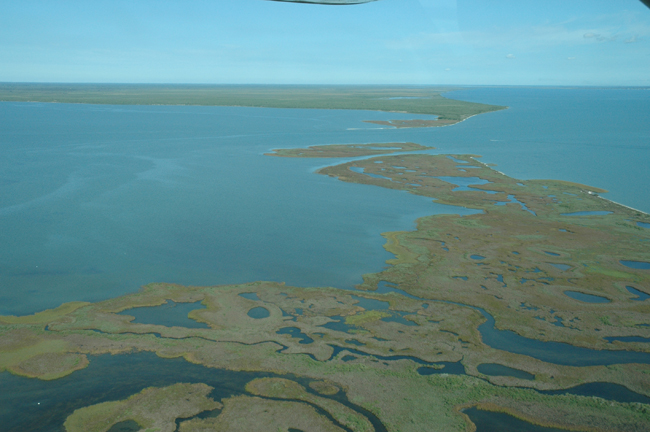
one of the main predators for shrimp (Jamall, 2012). Elsewhere, coastal wetland
habitats also suffer. The before-mentioned NWF report described wetlands as in
“continued decline” due to oil contamination (Inkley 2013). Wetlands are very
important in the upbringing and maturing of juvenile shrimp in the Gulf. These
two problems, predator and habitat decline, conjoined, present another problem
for shrimp in the Gulf. Shrimp have long been on a Type III survivorship curve,
meaning, mortality rates in the early stages of life are very high, but drop
very quickly (Thompson, 2014). Usually female shrimp lay between half a million
to a million eggs (Fishwatch, 2014). Few get fertilize, fewer hatch and fewer
make it to wetlands, where it is much safer and mortality rates drop
significantly. However, if wetlands are contaminated and inhospitable, shrimp
will die at a faster rate than normal, which will throw the survivorship curve,
which has existed for thousands of years, off (Thompson, 2014). Shrimp have
adjusted to surviving consistently after making it to the wetlands and if this
is not the case population could be severely affected. Declining red snapper
population may cause further problems in the survivorship curve. A 2005 study
conducted by Mexican researcher Roberto Perez-Castaneda examined growth and
mortality of shrimp in the Mexican lagoon, a wetland area. His study found that
“growth rates significantly decreased with relative abundance of [shrimp], whereas
mortality rates increased” (Perez-Castaneda, 2005). Since red snapper is a key
predator of shrimp, their decline may cause more shrimp to reach the wetlands,
increasing the abundance and density in the wetland areas. As Perez-Castaneda’s
study showed, this will have negative impacts on shrimp populations over time,
probably due to increased competition for food. This will once again change the
survivorship curve and combined with the persistent destruction of the wetlands
will only become worse as less wetland will mean higher density and higher
mortality. The survivorship curve of shrimp may undergo some very big changes,
and instead of a consistent mortality rate from juvenility onwards, the may be
a spike during early adulthood. Of course, this has not happened yet, but the threat
still remains.
 |
| http://www.algebralab.org/img/f4219546-c7c3-4b13-a990-972efc254c33.gif |
References
"Birth Defects." HowMed.net. HowMed, Web. 21 Feb. 2014. http://howmed.net/anatomy/embryology/birth-defects/
Burdeau, Cain. "Fishing Industry Still Reeling From Effects of 2010 BP Oil Spill."TheDenverPost.com. The Denver Post, Web. 21 Feb. 2014. http://www.denverpost.com/ci_20818044/fishing-industry-still-reeling-from-effects-2010-bp
Crash Course. (18 December 2012) Ecosystem Ecology: Links in the Chain. Ecosystem Ecology: Links in the Chain – Crash Course Ecology #7. YouTube. Web. 20 Feb. 2014. http://www.youtube.com/watch?v=v6ubvEJ3KGM&list=PL8dPuuaLjXtNdTKZkV_GiIYXpV9w4WxbX
Crash Course. (18 December 2012) Ecosystem Ecology: Links in the Chain. Ecosystem Ecology: Links in the Chain – Crash Course Ecology #7. YouTube. Web. 20 Feb. 2014. http://www.youtube.com/watch?v=v6ubvEJ3KGM&list=PL8dPuuaLjXtNdTKZkV_GiIYXpV9w4WxbX
"Energy Flow and Nutrient Cycles." S-Cool.co.uk. S-Cool Youth, n.d. Web. 21 Feb. 2014. http://www.s-cool.co.uk/a-level/biology/ecological-concepts/revise-it/energy-flow-and-nutrient-cycles
"Gulf of Mexico Oil Leak 'Worst US Environment Disaster'" BBC News. BBC, 30 May 2010. Web. 21 Feb. 2014. http://www.bbc.co.uk/news/10194335
"How Does the BP Oil Spill Affect Wildlife and Habitat." NWF.org. National Wildlife Federation, Web. 21 Feb. 2014. https://www.nwf.org/What-We-Do/Protect-Habitat/Gulf-Restoration/Oil-Spill/Effects-on-Wildlife.aspx
Inkley, D.B. (April 2013) Restoring a Degraded Gulf of Mexico. National Wildlife Federation. Web. 20 Feb. 2014. http://www.nwf.org/pdf/Wildlife/2013_NWF_Restoring_Gulf_Report_FINAL.pdf
Inkley, D.B. (April 2013) Restoring a Degraded Gulf of Mexico. National Wildlife Federation. Web. 20 Feb. 2014. http://www.nwf.org/pdf/Wildlife/2013_NWF_Restoring_Gulf_Report_FINAL.pdf
Jamall, Dahr. "Gulf Seafood Deformities Alarm Scientists." Aljazeera.com. Aljazeera, 20 Apr. 2012. Web. 21 Feb. 2014. http://www.aljazeera.com/indepth/features/2012/04/201241682318260912.html
McConnaughey, Janet. "BP Oil Spill Dispersants May Hurt Gulf of Mexico Food Chain." Nola.com. The Associated Press, 31 July 2012. Web. 21 Feb. 2014. http://www.nola.com/news/gulf-oil-spill/index.ssf/2012/07/bp_oil_spill_dispersants_may_h.html
Pallardy, Richard. "Deepwater Horizon Oil Spill of 2010." Encyclopedia Britannica Online. Encyclopedia Britannica, Web. 21 Feb. 2014. http://www.britannica.com/EBchecked/topic/1698988/Deepwater-Horizon-oil-spill-of-2010
Perez-Castaneda, R. (2005) Growth and mortality of transient shrimp populations (Farfantepenaeus spp.) in a coastal lagoon of Mexico: role of the environment and density-dependence. ICES Journal of Marine Science. Web. 20 Feb. 2014. http://icesjms.oxfordjournals.org/content/62/1/14.full
Perez-Castaneda, R. (2005) Growth and mortality of transient shrimp populations (Farfantepenaeus spp.) in a coastal lagoon of Mexico: role of the environment and density-dependence. ICES Journal of Marine Science. Web. 20 Feb. 2014. http://icesjms.oxfordjournals.org/content/62/1/14.full
"Polycyclic Aromatic Hydrocarbons." EPA.com. United States Environmental Protection Agency, Jan. 2008. Web. 21 Feb. 2014. http://www.epa.gov/waste/hazard/wastemin/minimize/factshts/pahs.pdf
"Polycyclic Aromatic Hydrocarbons." ATSDR.CDC.gov. Agency for Toxic Substances and Disease Registry, 1 July 2009. Web. 21 Feb. 2014. http://www.atsdr.cdc.gov/csem/csem.asp?csem=13&po=0
"Restoring a Degraded Gulf of Mexico." NWF.org. National Wildlife Federation, Apr. 2013. Web. 21 Feb. 2014. http://www.nwf.org/pdf/Wildlife/2013_NWF_Restoring_Gulf_Report_FINAL.pdf
Thompson, J. (2014) population ecology. Population ecology. Britannica. Web. 20 Feb. 2014. http://www.britannica.com/EBchecked/topic/470416/population-ecology/70574/Survivorship-curves?anchor=ref588052
"ToxFAQs™ for 2-Butoxyethanol and 2-Butoxyethanol Acetate." ATSDR.CDC.gov. Agency for Toxic Substances and Disease Registry, Aug. 1999. Web. 21 Feb. 2014. http://www.atsdr.cdc.gov/toxfaqs/TF.asp?id=346&tid=61
Van Den Avyle, M. J., S. C. Larson, and E. L. Bozeman, Jr. "Species Profiles: Life Histories and Environmental Requirements of Coastal Fishes and Invertebrates."NWRC.USGS.gov. U.S. Department of the Interior, 1989. Web. 21 Feb. 2014. http://www.nwrc.usgs.gov/wdb/pub/species_profiles/82_11-090.pdf
"White Shrimp." FishWatch.gov. NOAA, n.d. Web. 21 Feb. 2014. http://www.fishwatch.gov/seafood_profiles/species/shrimp/species_pages/white_shrimp.htm
Photographs
Photographs
http://2.bp.blogspot.com/-HmA--u1nB7A/T5AaD6mm6DI/AAAAAAAAMG8/Uv-9HSImF9A/s1600/bpfishdeformation.jpg

